Simulating a signal#
Here we describe the HeterodynedCWSimulator class for simulating a
signal from a continuous wave source after application of a heterodyne as described in Equations 7
and 8 of [1].
When generating the signal using the model() method, the
default is to assume that the phase evolution used in the heterodyne exactly matches the signal’s
phase evolution and that emission is from the \(l=m=2\) quadrupole mode (a triaxial source
emitting at twice the rotation frequency), i.e., the \(\Delta\phi\) term in Equations 8 of [1]
is zero. If the file/object that provides the signal parameters contains parameters for
non-tensorial polarisation modes (i.e., if assuming emission is not purely as given by general
relativity; see Table 6 of [1] for the names of the required parameters) then those polarisations
will be included in the signal (e.g., Equation 11 of [1]), otherwise general relativity will be
assumed and only the “+” and “×” polarisations included.
The model() method can also generate model amplitude
coefficients for use in a “pre-summed” likelihood function, as described in Appendix C and Equations
C8 and C12 of [1], by passing the outputampcoeffs argument as True. For a GR signal this
means two complex amplitude values get returned, while for non-GR signals six complex amplitudes are
returned.
The signal model at the rotation frequency, i.e., from the \(l=2,m=1\) mode, can be set by
passing freqfactor=1.0 as an argument to model().
This requires that the file/object containing the source parameters has the \(C_{21}\) and
\(\Phi_{21}\) parameters defined as given in Equation 7 of [1].
Note
If generating a simulated signal in IPython or a Jupyter notebook,
creating an instance of this class can be very slow (taking minutes
compared to a fraction of a second), due to redirections of
stdout/stderr in the SWIG-wrapped LIGOTimeGPS class. To
avoid this the call to HeterodynedCWSimulator
should be either done within a context manager, e.g.,:
import lal

with lal.no_swig_redirect_standard_output_error():
      sim = HeterodyneCWSimulator(...)
or by globally disabling redirection with:
import lal

lal.swig_redirect_standard_output_error(True)

sim = HeterodyneCWSimulator(...)
Phase offset signal#
The model() method can also be used to generate a signal
that is offset, in terms of its phase evolution, from the heterodyne phase. This can be used to
simulate cases where the heterodyned was not performed with an identical phase evolution to the
signal (due to differences between the source rotational/binary parameters). The pulsar parameter
file/object passed when constructing a HeterodynedCWSimulator object is
assumed to contain the parameters for the heterodyne phase model, while
model() can be passed an “updated” file/object
containing potentially different (phase) parameters that are the “true” source parameters using the
newpar argument (and updateX arguments for defining which components of the phase evolution
need updating compared to the heterodyne values). The difference in phase, as calculated using
Equation 10 of [1], will then be used when generating the signal.
If you want to calculate the signal with a phase offset from a fixed “heterodyne” frequency (i.e., a
reference frequency with no barycentring corrections applied, for example, a single FFT frequency
bin) and reference epoch, then rather than supplying a pulsar parameter file when constructing a
HeterodynedCWSimulator, you can supply the ref_freq and ref_epoch
keyword arguments. In this case the ref_freq should still be an equivalent of a pulsar’s
rotational frequency and will have the freq_factor argument of the
model() applied to it.
Using Tempo2#
By default, the phase difference evolution will be calculated using functions within LALSuite, which
has its own routines for calculating the solar system and binary system delay terms. However, if the
Tempo2 pulsar timing software [2], and the
libstempo Python wrapper for this, are installed, then
Tempo2 can instead be used for the generation of the phase evolution. This is done by setting the
usetempo2 argument to model() to True.
Note
If using Tempo2 you cannot use the updateX keyword arguments to specify whether or not to
recalculate a component of the phase model. All components will be regenerated if present.
Examples#
An example usage to generate the complex heterodyned signal time series is:
from cwinpy.signal import HeterodynedCWSimulator
from cwinpy import PulsarParameters
from astropy.time import Time
from astropy.coordinates import SkyCoord
import numpy as np

# set the pulsar parameters
par = PulsarParameters()
pos = SkyCoord("01:23:34.5 -45:01:23.4", unit=("hourangle", "deg"))
par["PSRJ"] = "J0123-4501"
par["RAJ"] = pos.ra.rad
par["DECJ"] = pos.dec.rad
par["F"] = [123.456789, -9.87654321e-12]  # frequency and first derivative
par["PEPOCH"] = Time(58000, format="mjd", scale="tt").gps  # frequency epoch
par["H0"] = 5.6e-26     # GW amplitude
par["COSIOTA"] = -0.2   # cosine of inclination angle
par["PSI"] = 0.4        # polarization angle (rads)
par["PHI0"] = 2.3       # initial phase (rads)

# set the GPS times of the data
times = np.arange(1000000000.0, 1000086400.0, 3600, dtype=np.float128)

# set the detector
det = "H1"  # the LIGO Hanford Observatory

# create the HeterodynedCWSimulator object
het = HeterodynedCWSimulator(par=par, det=det, times=times)

# get the model complex strain time series
model = het.model()
Note
If you have a pulsar parameter file you do not need to create a
PulsarParameters object, you can just pass the path of that file, e.g.,
par = "J0537-6910.par"
het = HeterodynedCWSimulator(par=par, det=det, times=times)
An example (showing both use of the default phase evolution calculation and that using Tempo2) of getting the time series for a signal that has phase parameters that are not identical to the heterodyned parameters would be:
from cwinpy.signal import HeterodynedCWSimulator
from cwinpy import PulsarParameters
from astropy.time import Time
from astropy.coordinates import SkyCoord
from copy import deepcopy
import numpy as np

# set the "heterodyne" pulsar parameters
par = PulsarParameters()
pos = SkyCoord("01:23:34.5 -45:01:23.4", unit=("hourangle", "deg"))
par["PSRJ"] = "J0123-4501"
par["RAJ"] = pos.ra.rad
par["DECJ"] = pos.dec.rad
par["F"] = [123.4567, -9.876e-12]  # frequency and first derivative
par["PEPOCH"] = Time(58000, format="mjd", scale="tt").gps  # frequency epoch
par["H0"] = 5.6e-26     # GW amplitude
par["COSIOTA"] = -0.2   # cosine of inclination angle
par["PSI"] = 0.4        # polarization angle (rads)
par["PHI0"] = 2.3       # initial phase (rads)

# set the times
times = np.arange(1000000000.0, 1000086400.0, 600, dtype=np.float128)

# set the detector
det = "H1"  # the LIGO Hanford Observatory

# create the HeterodynedCWSimulator object
het = HeterodynedCWSimulator(par=par, det=det, times=times)

# set the updated parameters
parupdate = deepcopy(par)
parupdate["RAJ"] = pos.ra.rad + 0.001
parupdate["DECJ"] = pos.dec.rad - 0.001
parupdate["F"] = [123.456789, -9.87654321e-12]  # different frequency and first derivative

# get the model complex strain time series
model = het.model(parupdate, updateSSB=True)
# equivalently you could use the class in callable mode with
# model = het(parupdate, updateSSB=True)

# do the same but using Tempo2
hettempo2 = HeterodynedCWSimulator(par=par, det=det, times=times, usetempo2=True)
modeltempo2 = hettempo2.model(parupdate)
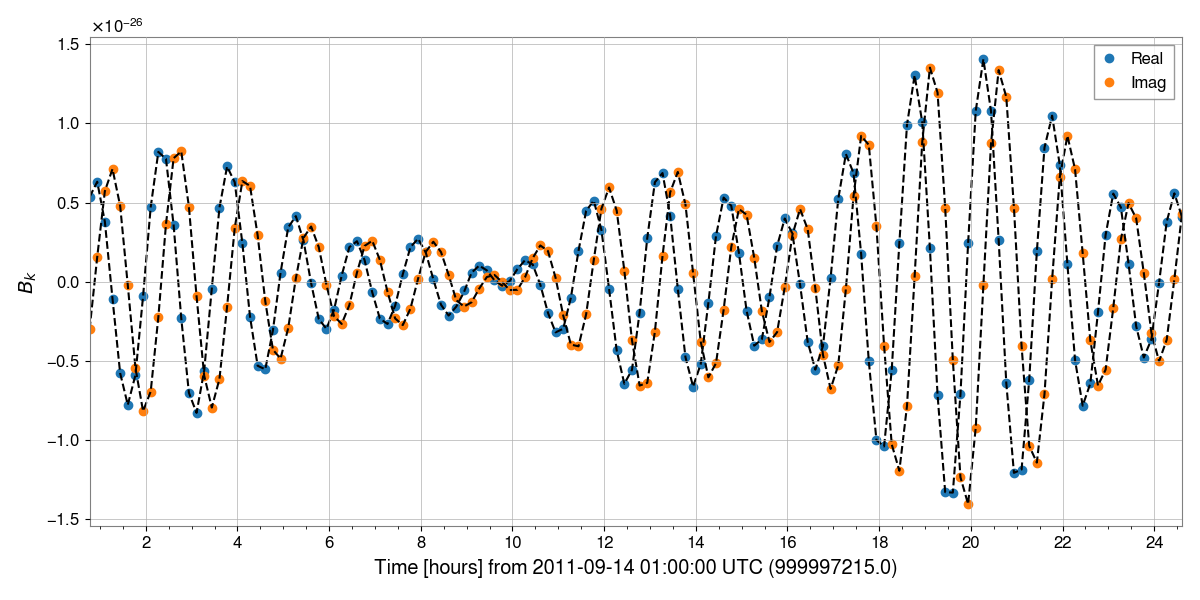
Overplotting these (the Tempo2 version is shown as black dashed lines) we see:
from cwinpy import HeterodynedData

hetdata = HeterodynedData(model, times=times, detector=det, par=parupdate)
fig = hetdata.plot(which="both")
ax = fig.gca()

# over plot Tempo2 version
ax.plot(times, modeltempo2.real, "k--")
ax.plot(times, modeltempo2.imag, "k--")
fig.tight_layout()
Note
For signals from sources in binary systems there will be a phase offset between signals heterodyned using the default LALSuite functions and those using Tempo2. This offset is not present for non-binary sources. In general this is not problematic, but if using Tempo2 it will mean that the recovered initial phase will not be consistent with the expected value.
In this example using Tempo2 is several hundred times slower, but still runs in about a hundred ms rather than a couple of hundred μs.
Signal API#
- class HeterodynedCWSimulator(par=None, det=None, times=None, earth_ephem=None, sun_ephem=None, ephem='DE405', units='TCB', usetempo2=False, t0=None, dt=None, ref_freq=None, ref_epoch=None)#
Bases:
objectA class to simulate strain data for a continuous gravitational-wave signal after the data has been heterodyned, i.e., after multiplying the data by a complex phase vector. This uses the Equations 7 and 8 from [1] accessed via the
XLALHeterodynedPulsarGetModel()function.- Parameters:
par (str, PulsarParameters) – A Tempo-style text file, or a
PulsarParametersobject, containing the parameters for the source, in particular the phase parameters at which the data is “heterodyned”. This is required unless you are specifying aref_freqfor a static frame.det (str) – The name of a gravitational-wave detector at with to simulate the signal. This is required.
times (array_like) – An array of GPS times at which to calculate the heterodyned strain.
t0 (float) – A time epoch in GPS seconds at which to calculate the detector response function. If not given and
timesis set, then the first value oftimeswill be used.dt (int, float) – The time steps (in seconds) in the data over which to average the detector response. If not given and
timesis set, then the time difference between the first two values intimeswill be used.earth_ephem (str) – A file containing the LALSuite-style Earth ephemeris information. If not set then a default file will be used.
sun_ephem (str) – A file containing the LALSuite-style Sun ephemeris information. If not set then a default file will be used.
ephem (str) – The solar system ephemeris system to use for the Earth and Sun ephemeris, i.e.,
"DE200","DE405","DE421", or"DE430". By default theEPHEMvalue from the suppliedparwill be used, but if not found, and if this value is not set, it will default to"DE405".units (str) – The time system used, i.e.,
"TDB"or"TCB". By default theUNITSvalue from theparwill be used, but if not found, and if this value is not set, it will (like TEMPO2) default to"TCB".usetempo2 (bool) – Set to True to use TEMPO2, via libstempo, for calculating the phase of the signal. To use libstempo must be installed. If using TEMPO2 the Earth, Sun and time ephemerides, and the
ephemandunitsarguments are not required. Information on the correct ephemeris will all be calculated internally by TEMPO2 using the information from the pulsar parameter file.ref_freq (float) –
Use this to set the source rotation frequency (Hz) if simulating an initial heterodyne at a fixed frequency without any barycentring. This will set the barycentring delays to zero, or, if using Tempo2, the “original” phase will be calculated at the SSB. This will be ignored if a
parfile is supplied.A reference epoch must either be supplied using the
ref_epochargument, or it will be taken to be the first supplied time stamp.
- model(newpar=None, updateSSB=False, updateBSB=False, updateglphase=False, updatefitwaves=False, freqfactor=2.0, outputampcoeffs=False, roq=False, phase_only=False)#
Compute the heterodyned strain model using
XLALHeterodynedPulsarGetModel().- Parameters:
newpar (str, PulsarParameters) – A text parameter file, or
PulsarParametersobject, containing a set of parameter at which to calculate the strain model. If this isNonethen the “heterodyne” parameters are used.updateSSB (bool) – Set to
Trueto update the solar system barycentring time delays compared to those used in heterodyning, i.e., if thenewparcontains updated positional parameters.updateBSB (bool) – Set to
Trueto update the binary system barycentring time delays compared to those used in heterodying, i.e., if thenewparcontains updated binary system parametersupdateglphase (bool) – Set to
Trueto update the pulsar glitch evolution compared to that used in heterodyning, i.e., if thenewparcontains updated glitch parameters.updatefitwaves (bool) – Set to
Trueto update the pulsar FITWAVES phase evolution (used to model strong red timing noise) compared to that used in heterodyning.freqfactor (int, float) – The factor by which the frequency evolution is multiplied for the source model. This defaults to 2 for emission from the \(l=m=2\) quadrupole mode.
outputampcoeffs (bool) – If
False(default) then the full complex time series of the signal (calculated at the time steps used when initialising the object) will be output. IfTrueonly two complex amplitudes (six for non-GR sources) will be output for use when a pre-summed signal model is being used - this should only be used if phase parameters are not being updated.roq (bool) – A boolean value to set to
Trueif requiring the output for a ROQ model (NOT YET IMPLEMENTED).phase_only (bool) – Just return the phase evolution of the signal. If a
newparis supplied it will return the phase difference.
- Returns:
strain – A complex array containing the strain data
- Return type:
array_like
- phase_evolution(newpar=None, freqfactor=2.0, **kwargs)#
Return the phase evolution of the signal. If
newparis supplied then the phase difference will be output, otherwise phase evolution of the original input par file will be output. Seemodel()for input arguments. If you created theHeterodynedCWSimulatorusing a reference frequency and you are supplying anewpar,the “update” keyword arguments will all default toTrue, but otherwise default toFalse.
- property resp#
Return the response function look-up table.